Stop Wasting Money on Automation Tech That Doesn’t Fit Your Business: Why Your Roadmap Matters More Than Your Equipment
Hook (Pattern Interrupt + Pain Amplification)
Your competitor just installed a $250,000 robotic cell. You’re thinking: “We need to do the same—and fast.”
Stop.
Not sure where your automation stands? Take our 2-minute Automation Readiness Survey to find out. Take Survey
Here’s what they won’t tell you: That shiny new robot might be sitting idle within 18 months. Not because the technology failed, but because they never had a plan for it in the first place.
In 2025, 42% of companies abandoned most of their automation initiatives before reaching production—up dramatically from just 17% the previous year. Industry data shows that 90% of automation projects fail due to technical issues, 37% due to implementation costs, and 25% because of no overall vision or strategy.
The math is brutal: Manufacturers are bleeding millions on automation that never delivers ROI—not because the technology doesn’t work, but because they bought equipment before building a strategy.
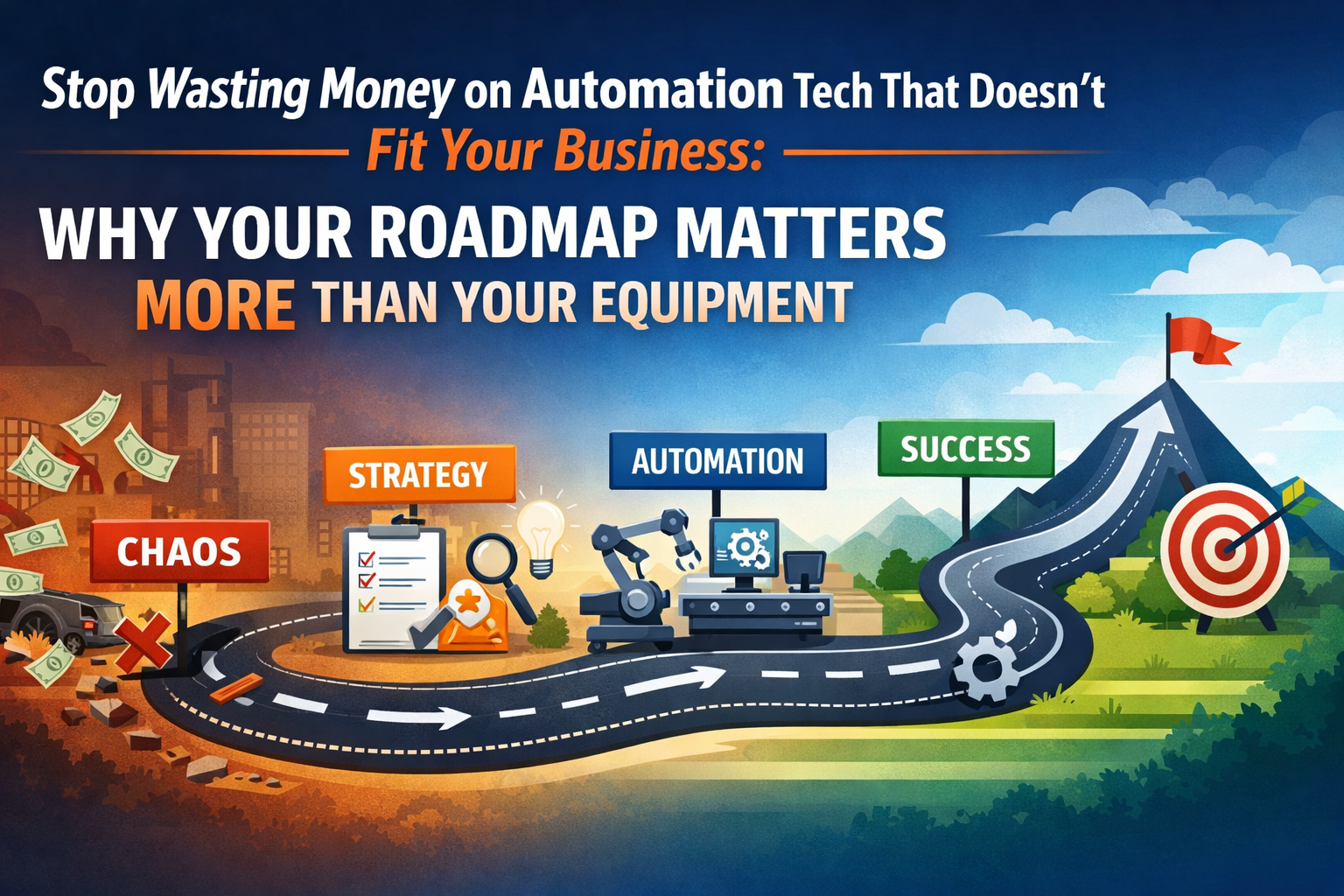
The Problem: Equipment-First Thinking Costs You More Than Money
Walk into most manufacturing facilities today, and you’ll see a graveyard of good intentions: robots gathering dust, software nobody uses, conveyors that complicated workflows instead of streamlining them.
The pattern is always the same:
A manufacturer sees a competitor automate, attends a trade show, or gets pitched by a vendor. The technology looks impressive. The ROI projections are compelling. So they buy it.
Then reality hits.
The new equipment doesn’t integrate with existing systems. The production line has to shut down for weeks during installation. Employees don’t know how to use it—or worse, actively resist it. Suddenly, that 24-month ROI timeline stretches to 36 months, 48 months, or never.
Nearly half of manufacturers report moderate to significant challenges filling production and operations management roles, and 28% don’t even have a digital manufacturing strategy in place. Yet they’re buying automation equipment as if implementation happens in a vacuum.
Here’s the uncomfortable truth: Your automation isn’t failing because you bought the wrong robot. It’s failing because you never asked the right questions before buying anything at all.
Why Now: The 2025 Automation Landscape Demands Strategy First
The stakes have never been higher—or the opportunities greater.
The industrial automation market reached $226 billion in 2025 and is projected to hit $379 billion by 2030, driven by a 10.8% compound annual growth rate. AI integration, labor shortages, and Industry 4.0 pressures aren’t slowing down—they’re accelerating.
But here’s what’s changed: The manufacturers who succeed in 2025 aren’t the ones spending the most on technology. They’re the ones who plan the smartest.
In recent surveys, 46% of manufacturers ranked process automation as their first or second priority for investment within the next two years. That’s billions being allocated right now. The question is: will it be spent strategically or squandered reactively?
Your competitors are making their moves. Some are building roadmaps. Others are panic-buying equipment. In 24 months, the gap between these two groups will be impossible to close.
The Solution: The Strategic Power of an Automation Roadmap
An automation roadmap isn’t a wishlist. It’s not a vendor’s sales deck repackaged as strategy.
Not sure where your automation stands? Take our 2-minute Automation Readiness Survey to find out. Take Survey
A true automation roadmap is a business blueprint that answers five critical questions before you spend a single dollar on equipment:
1. What business outcomes are we actually trying to achieve?
Not “automate Line 3.” Not “get a cobot.”
Real outcomes: Increase throughput by 30%. Reduce defects by half. Cut labor costs while creating better jobs. Meet customer demand we’re currently turning away.
An automation roadmap starts with your business goals and works backward to technology—not the other way around.
2. What are our current process bottlenecks and opportunities?
Effective roadmaps begin by inventorying every manual and semi-automated process, capturing metrics like cycle time, error rate, and cost per transaction, then identifying pain points with high volume, high cost, or frequent errors.
You might discover that your biggest opportunity isn’t the production line at all—it’s the data chaos in your quality control process or the three hours your team spends every day manually reconciling paperwork.
3. What’s our phased implementation plan?
The most successful automation implementations target ROI within 7-18 months through phased, modular approaches rather than massive all-at-once overhauls.
A roadmap breaks your automation journey into digestible phases:
- Phase 1: Automate repetitive tasks with proven ROI
- Phase 2: Integrate data systems for visibility
- Phase 3: Scale automation across production lines
- Phase 4: Implement AI-powered optimization
Each phase builds on the last. Each phase delivers measurable value. And crucially, each phase gives you the option to course-correct before you’re in too deep.
4. How will we prepare our workforce?
Research shows that 91% of managers now prioritize upskilling initiatives, supported by 70% of workers, recognizing that automation enhances decision-making and productivity rather than displacing teams.
Equipment fails when people aren’t ready for it. A roadmap accounts for training timelines, change management, and workforce development parallel to technology deployment.
5. How do we future-proof for scalability?
Your roadmap isn’t just about solving today’s problems. It’s about building a foundation that can scale as your business grows, adapt as technology evolves, and integrate as Industry 4.0 capabilities mature.
Manufacturers who implement scalable automation systems can quickly adjust to increasing demand or tackle new challenges, confirming that operations can grow without sacrificing performance, efficiency, or quality.
Real-World Impact: Roadmap vs. No Roadmap
Let’s contrast two manufacturers—both mid-sized, both in automotive parts, both facing the same labor shortage crisis.
Manufacturer A (No Roadmap):
Sees a competitor install cobots. Spends $400K on three collaborative robots within 90 days. Discovers they need new fixtures, different part orientations, and safety upgrades. Training takes 6 months longer than expected. Employee pushback is significant. The robots run at 40% capacity after 18 months. Actual ROI: Still negative at Month 24.
Manufacturer B (Roadmap-First):
Spends three months building an automation roadmap with an automation strategist. Identifies that material handling—not assembly—is the highest-impact automation opportunity. Phases implementation: starts with a single cobot on the most repetitive task, measures results, trains operators, gathers feedback. Scales to three robots over 12 months. Each deployment is smoother than the last. Actual ROI: Positive at Month 14. Production throughput up 28%. Zero employee resistance.
The difference? Manufacturer B spent money on planning before spending money on equipment. They asked “why” and “how” before asking “what” and “when.”
Not sure where your automation stands? Take our 2-minute Automation Readiness Survey to find out. Take Survey
The JAE Approach: Strategy Before Spending
At JAE Automation, we’ve seen this story play out hundreds of times. The manufacturers who succeed are the ones who approach automation as a business transformation—not a technology purchase.
That’s why our Automation Strategy service exists. We partner with small-to-medium manufacturers to build comprehensive automation roadmaps that:
✅ Align technology with your business goals —not vendor capabilities
✅ Identify phased implementation paths —so you see ROI before scaling
✅ Account for your workforce and culture —because technology only works if people embrace it
✅ Design for scalability —so your first automation investment isn’t your last
✅ Connect to your existing systems —eliminating integration nightmares
We’re not here to sell you a robot. We’re here to help you build a manufacturing operation that’s more competitive, more productive, and creates better jobs for your team.
Because when you get the roadmap right, the equipment decisions become obvious.
Stop buying automation equipment. Start building an automation strategy.
Before you sign another equipment purchase order, ask yourself: Do we have a clear roadmap, or are we just hoping this works?
JAE Automation offers complimentary Automation Readiness Assessments to help manufacturers understand where they are today—and chart a clear path to where they need to be.
Not sure where your automation stands? Take our 2-minute Automation Readiness Survey to find out. Take Survey
Download our free Automation Roadmap Starter Checklist — a practical guide to the 12 questions you must answer before your next automation investment.
Or schedule a no-obligation Automation Strategy consultation with our team. We’ll help you determine if a roadmap makes sense for your operation, what it should include, and how to get started—whether you work with us or not.
Making things: better™ starts with making better plans.